


















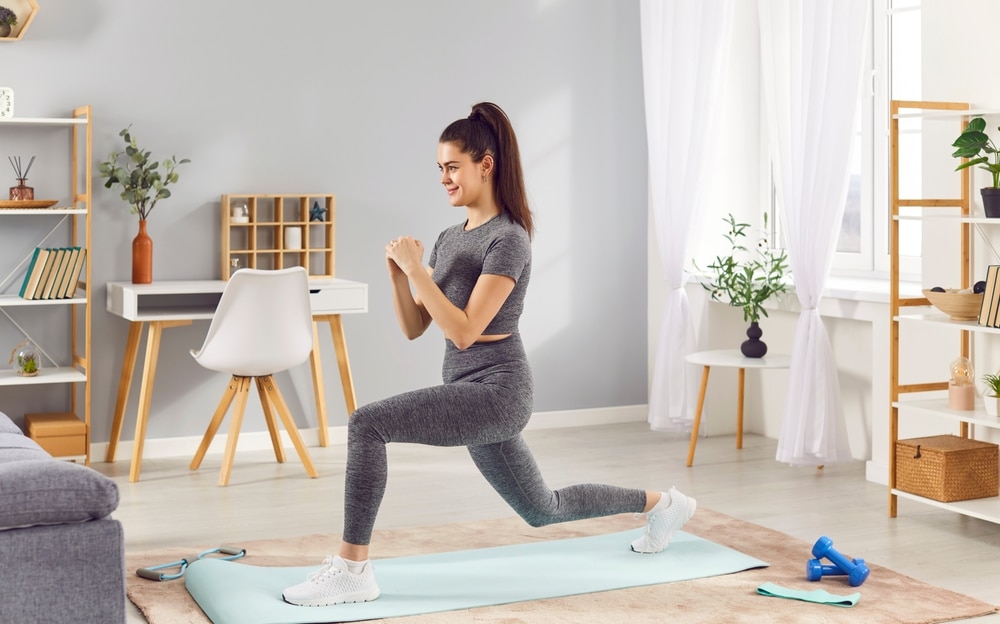
When it comes to measuring lower-body longevity and functional power, few exercises are as revealing as the lunge. While the squat is often celebrated as the “king of exercises,” the lunge offers a more nuanced look at how our bodies move in the real world. For those navigating their mid-50s and beyond, the ability to perform this movement with precision is one of the most accurate indicators of biological age versus chronological age.
The challenge of the lunge lies in its unilateral nature. Because you are supporting your weight on one leg at a time, the move demands an intricate dance of coordination, balance, and stabilizer muscle engagement. Many fitness enthusiasts who can move heavy weights on a leg press machine often struggle with basic lunges because they lack the “functional” strength required to stabilize the hips and knees independently.
This Benchmark Signals Top-Tier Leg Strength
If you are over the age of 55 and looking for a way to gauge your fitness, there is a specific metric that separates the average from the elite. According to Joshua King, a Personal Training Leader at Life Time Gainesville, the “gold standard” for leg strength in this age bracket is the ability to complete 50 total repetitions. Whether performed in one continuous set or broken into smaller segments, reaching this number with perfect form puts you in the top 10% of your age group.
However, King emphasizes that hitting the number is meaningless if the mechanics are flawed. To truly pass this strength test, the movement must be defined by quality. This means maintaining an upright torso, achieving a full range of motion where the back knee nears the floor, and showing total control over the front knee. If your knee wobbles inward or your torso collapses forward, you haven’t yet mastered the movement’s demands.
Why Lunges Are an Effective Test of Lower-Body Strength
The lunge is essentially a diagnostic tool for the human body. Because it isolates one side, it immediately “audits” your physique for imbalances. Most people have a dominant side that compensates for a weaker one during bilateral movements like squats or deadlifts. Lunges strip away that advantage, forcing each leg to prove its own worth.
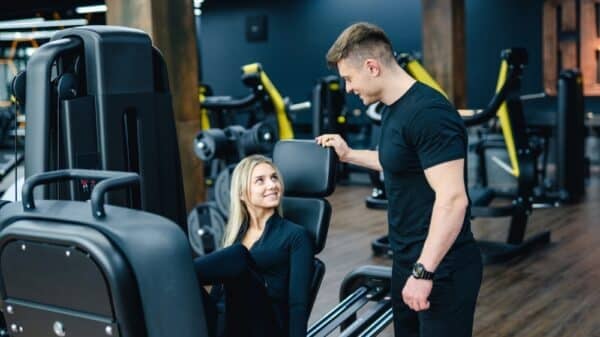
King points out that lunges provide a much more comprehensive assessment than seated leg machines. A lunge doesn’t just work the primary movers like the quadriceps and glutes; it recruits the hamstrings, calves, and the deep stabilizers of the core. It is a full-body integration test that shows how well your nervous system communicates with your muscular system to maintain uprightness under tension.
How Lunges Compare to Squats When Measuring Functional Strength
While squats are excellent for building raw power and bone density, they don’t always translate directly to the movements of daily life. In a squat, your feet are fixed, providing a stable base that allows the body to distribute weight evenly. Lunges, conversely, require you to manage your center of gravity while moving through space.
“In relation to functionality, lunges require the body to manage forward and downward movement through space,” King explains. This dynamic nature mimics the demands of climbing steep stairs, stepping off a high curb, or recovering your balance after a trip. For older adults, this “deceleration” strength—the ability to control the body as it moves downward—is the primary defense against falls and joint injuries.
What This Indicates About Your Stability and Mobility
Mastering the lunge indicates more than just strong muscles; it signals healthy joints. To perform a deep lunge, you need significant mobility in the hips and ankles, as well as stability in the knee joint. If you can perform these reps repeatedly without pain or loss of balance, it suggests that your “functional capacity” is significantly higher than that of the average person your age.
Furthermore, maintaining this level of strength into your 50s and 60s serves as a protective shield for the long term. It indicates that you have trained your body to move with a level of sophistication that protects the lower back and prevents the typical “stiff” gait often associated with aging. Essentially, if you can lunge well, you can move well in almost every other area of life.
In summary, the 50-repetition lunge test is a powerful benchmark for anyone over 55. It measures more than just the size of your leg muscles; it evaluates your balance, your joint health, and your ability to remain mobile and independent for decades to come. If you find you aren’t quite at the 50-rep mark yet, use it as a goal to work toward, focusing first on the stability of your knees and the upright posture of your spine before increasing the volume.