



















The health implications of consuming processed meats, such as bacon, ham, sausages, and deli meats, have been a subject of intense scientific scrutiny. In 2018, the International Agency for Research on Cancer (IARC), an arm of the World Health Organization, formally categorized processed meat as a Group 1 carcinogen. This designation places these foods in the same evidence-based category as tobacco and asbestos. While this classification refers to the certainty of the evidence rather than the potency of the hazard, it highlights a significant public health concern regarding regular meat consumption.
The Scientific Consensus on Processed Meat and Cancer
The IARC’s decision to label processed meats as Group 1 carcinogens was based on extensive research confirming their role in causing colorectal cancer. Some critics have questioned the grouping, pointing out that eating a ham sandwich is not the same as exposure to mustard gas. However, the classification system is designed to measure the strength of the scientific evidence proving a substance causes cancer, not the level of risk it poses to an individual. While plutonium and pastrami share the same classification, the danger levels differ; nevertheless, the evidence that both can cause cancer in humans is equally robust.
Quantifying Your Risk: Relative vs. Absolute Statistics
Understanding the actual risk requires looking at the data through two lenses: relative and absolute risk. Research indicates that consuming 50 grams of processed meat daily—roughly the equivalent of one hot dog, two slices of ham, or two breakfast links—is associated with an 18% increase in the relative risk of developing colorectal cancer. For those who consume larger portions, such as a half-pound of deli meat, that risk could escalate by as much as 80%.
To put this in perspective, if the average person has a 5% lifetime risk of developing colorectal cancer, an 18% increase in relative risk raises that absolute risk to approximately 6%. While a 1% shift may seem small for an individual, the impact on a population level is massive. In the United States, shifting dietary habits away from processed meats could prevent an estimated 25,000 cases of colorectal cancer every year, sparing thousands of families from a difficult diagnosis.
Comparing the Impact: Processed Meat vs. Environmental Hazards
The health risks associated with processed meat are often compared to other well-known hazards. For example, the Surgeon General has noted that living with a smoker increases the risk of lung cancer by about 15%. This means that the daily consumption of processed meat carries a statistical risk for colorectal cancer that is remarkably similar to the risk of lung cancer from chronic second-hand smoke exposure. This comparison underscores why public health advocates emphasize the importance of limiting processed meat intake, especially in school settings and childhood diets.
Beyond Cancer: The Broader Health Consequences of Processed Meat
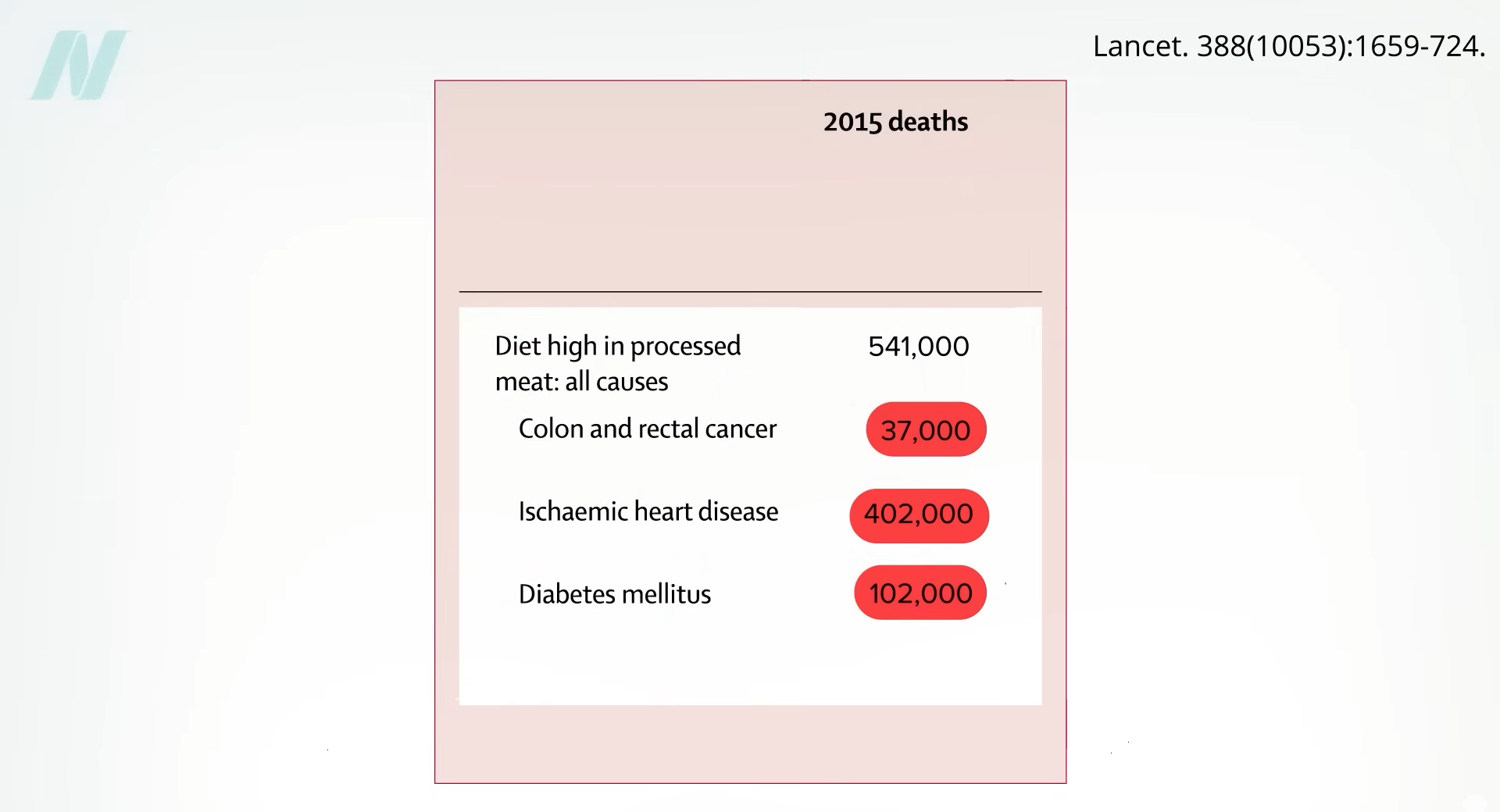
While the focus is often on colorectal cancer, the health risks of processed meats extend to other conditions. Data from the Global Burden of Disease studies suggests that while processed meat is linked to approximately 37,000 colorectal cancer deaths annually, its impact on other chronic diseases is even more staggering. High intake is associated with roughly 100,000 deaths from diabetes and 400,000 deaths from heart disease each year. Collectively, processed meat consumption may contribute to nearly half a million deaths annually across these major health categories.
Furthermore, emerging research conducted since the IARC’s initial report suggests potential links between processed meat consumption and increased risks for pancreatic, breast, and prostate cancers. This broader evidence base reinforces the recommendation to treat these foods as significant dietary stressors.
Closing the Gap in Medical Advice and Public Policy
Despite the growing body of evidence, consumption levels of processed meat in the United States have remained largely unchanged for nearly two decades. One reason for this may be the lack of clear communication in national dietary guidelines. While the scientific community recognizes processed meat as a carcinogen, official policy statements have often been less explicit. Additionally, a significant gap exists in clinical settings; reports indicate that 70% of cancer patients receive no nutritional guidance from their medical providers during or after their treatment.
Public health action is beginning to take shape in some regions. For instance, New York City has moved to ban processed meats from school lunch programs to protect children from known carcinogens early in life. In response, the meat industry has attempted to reformulate products by adding ingredients like fiber to mitigate the harmful effects, though health experts argue that removing the products from the diet is a more effective strategy for long-term health.
Key Takeaways for Reducing Colorectal Cancer Risk
Colorectal cancer remains the second leading cause of cancer-related deaths for men and women combined in the United States. For non-smokers, it represents one of the most significant health threats. However, the risk is highly manageable through lifestyle adjustments. By eliminating just one serving of processed meat per day and replacing it with plant-based alternatives like hummus or veggie-based proteins, individuals can reduce their cancer risk by nearly 20%. Prioritizing whole foods and advocating for clearer nutritional standards are essential steps in combating the health risks associated with processed meats.