


















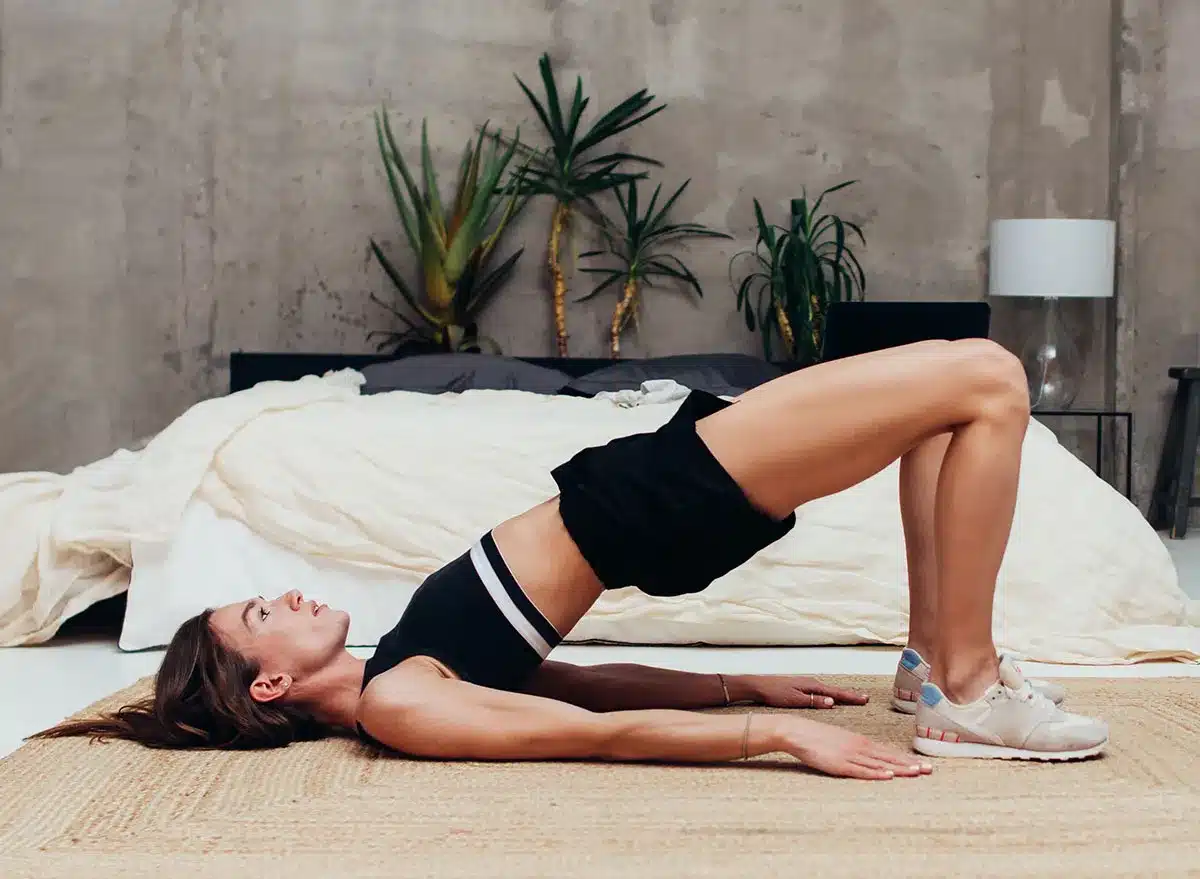
The bridge recruits the glutes and core together to build strength and stability.
Many trainers and fitness pros recommend adding bridges to your workout routine due to their many benefits. This low-impact movement builds strength and stability in the lower body while protecting the lower back and boosting mobility. What does that mobility part mean for everyday living? Building strong hips can help you stand from a seated position easier, balance your gait, avoid falls, and climb stairs without difficulty or hesitation.
We spoke with Rosie Borchert, NASM-CPT with REP Fitness, who shares a challenge. Try holding a bridge position this long after 55—if you can, know that your core strength is stronger than 90% of your peers.
How Does the Bridge Train the Core?
Glute bridges train the core by firing up the transverse abdominis (deep core), obliques, and lower back. Holding this position is also a solid indicator of glute strength. According to Borchert, the core and glutes work closely together to provide stability to the spine and pelvis during daily movement.
“The glute bridge isn’t typically classified as a ‘core movement,’ but that doesn’t mean the core isn’t involved,” Borchert explains. “Think of it like a road trip—the glutes are the driver and the core is the passenger, there to help keep the driver company so they can do their job well. While the gluteus maximus is what powers this move, the core engages to stabilize the pelvis, maintain spinal alignment, and keep the lower back from overextending.”
How the Bridge Works the Core Differently Than Classic Ab Exercises
Core training falls under one of the four umbrellas: flexion, anti-rotation, lateral flexion, and anti-extension. Exercises like crunches and sit-ups are dynamic flexion exercises, where your back is rounded and your spine bends forward. They activate the front side of the body—the rectus abdominis with support from the transverse abdominis and obliques.”A bridge, when looking at how it works for your core, would be considered an isometric, anti-extension exercise that targets the back side of your body. While your core isn’t powering the movement, it’s engaged as stabilizers, working to keep your body position aligned throughout the hold,” Borchert says.
What Bridge Hold Time Is a Solid Benchmark for Adults Over 55?

Shutterstock
If you’re in the 55-and-up age group, aiming to hold a glute bridge for 30 to 60 seconds shows solid glute and trunk endurance. Anything more than 60 seconds signals “excellent muscular endurance and above-average hip stability,” Borchert says.”Research has shown that the average hold time for younger adults (aged 18 to 35) sits around 60 to 100 seconds. While there haven’t been any studies done on older adults, lowering this target range accounts for the natural decline in muscle mass and endurance that occurs with aging. Ultimately, tackling this move with proper form, and working with progressive overload (increasing your time under tension from week to week as you get stronger), is more important than chasing a specific number,” she adds.