
















Achieving a stronger, more defined chest after the age of 50 does not necessarily require long hours at a professional gym. In fact, when it comes to late-life fitness, the efficiency of your workout routine is far more significant than the total time spent lifting weights. Focusing on high-quality movements can yield better results while protecting your physical longevity.
As we age, preserving skeletal muscle becomes a vital component of healthy living. Starting around the age of 50, many adults begin to experience sarcopenia, a condition characterized by the gradual loss of muscle mass and functional strength. Fortunately, resistance training remains one of the most effective strategies to combat this process. By engaging in targeted strength exercises, you can maintain muscle tissue, support your metabolism, and ensure you remain capable in your daily activities.
Building a toned upper body is highly achievable with basic equipment. Many of the most effective movements can be performed in the comfort of your home using dumbbells, resistance bands, or even stable household surfaces. James Bickerstaff, CPT, a fitness expert, suggests that specific exercises can outperform marathon gym sessions by focusing on the chest, shoulders, and triceps in a way that is accessible and joint-friendly.
Building Functional Upper Body Strength with Incline Push-ups
The incline push-up is a foundational exercise for adults over 50. By elevating the hands, you reduce the overall load on the joints compared to a standard floor push-up, making it an excellent choice for building strength without overstressing the shoulders.
How to perform this movement:
- Place your hands on a stable, elevated surface such as a countertop or a sturdy bench.
- Ensure your hands are positioned slightly wider than your shoulder width.
- Step your feet back until your body creates a straight, diagonal line from head to heels.
- Contract your core muscles and keep your shoulder blades retracted.
- Slowly lower your chest toward the surface by bending your elbows.
- Maintain a rigid posture, ensuring your hips do not sag or pike.
- Once your chest is near the surface, push through your palms to return to the start.
- Complete two to three sets of 8 to 15 repetitions, taking a 60-to-90-second break between sets.
Enhancing Muscle Balance via the Dumbbell Chest Press
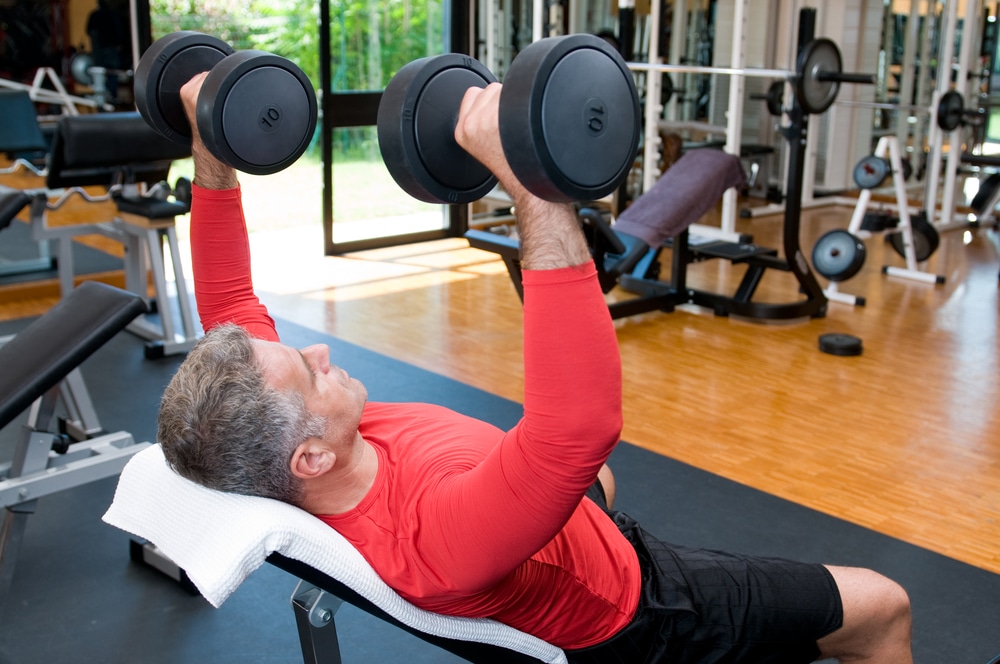
Unlike fixed weight machines, using dumbbells requires you to stabilize each arm independently. This helps address muscle imbalances and forces the smaller stabilizing muscles of the shoulder and chest to engage more deeply.
How to perform this movement:
- Lie flat on your back on a weight bench or a comfortable spot on the floor, holding a dumbbell in each hand.
- Select a weight that allows for smooth, controlled movements.
- Start with the weights positioned at the sides of your chest.
- Keep your feet planted firmly on the ground to provide a stable base.
- Keep your spine neutral and your core engaged throughout the lift.
- Extend your arms to press the weights toward the ceiling until they are almost straight.
- Hold the peak contraction for a second or two.
- Slowly lower the dumbbells back to the starting position at chest level.
- Aim for two to three sets of 8 to 12 repetitions, resting for 60 to 90 seconds between sets.
Targeting Pectorals with the Strategic Chest Squeeze Press
The squeeze press is a unique variation that prioritizes “time under tension.” By pressing the weights together, you maintain constant activation in the pectoral muscles, which can lead to significant strength gains without the need for excessively heavy weights.
How to perform this movement:
- Lie on a bench or the floor with a dumbbell in each hand.
- Bring the dumbbells together so they touch directly above the center of your chest.
- Maintain a constant inward pressure, squeezing the weights against each other.
- Slowly lower the weights toward your sternum while keeping them pressed together.
- Control the descent until the weights reach chest level.
- Press the weights back up to the starting position while maintaining the squeeze.
- Repeat the movement for two to three sets of 10 to 15 repetitions, resting for 45 to 60 seconds between sets.
Refining the Chest with Resistance Band Chest Flies
Resistance bands are an excellent tool for older adults because they provide a linear increase in tension throughout the range of motion. This allows for a deep stretch and a peak contraction that is often easier on the rotator cuffs and elbow joints than free-weight flies.
How to perform this movement:
- Secure a resistance band to a sturdy anchor point at chest height behind you.
- Hold a handle in each hand and take a small step forward to create initial tension.
- Stand with an upright posture and a slight bend in your knees.
- Keep your elbows slightly flexed to avoid joint strain.
- Bring your hands together in a wide arc in front of your chest.
- Pause at the center and squeeze your chest muscles for one to two seconds.
- Slowly reverse the motion back to the starting position, resisting the pull of the band.
- Perform two to three sets of 10 to 15 repetitions, resting for 45 to 60 seconds between sets.
Summary for Long-Term Strength
Preserving muscle mass after 50 is a cornerstone of longevity and physical independence. By integrating these four targeted chest exercises into your routine, you can effectively combat sarcopenia and build a stronger upper body. These movements prioritize joint health and muscle activation, proving that you don’t need a gym full of equipment to see significant physical improvements. Consistency and proper form are the most important factors in staying strong and lean as you age.